Scheduling is all you need: use sparsity to save time while controlling loss.
Six MiniMax H3 execution paths receive the same first frame, prompt, seed, checkpoint, resolution, and duration. The Turbo profile and attention schedule change; measured wall time is reported for every sequence. A complete 55-render integer handoff sweep follows at the bottom.
Sequences
6 + 55 sweep
Seed
260827104729
Format
768² · 15.08 s
Base
MiniMax H3 FL2VA
01 / 4-step family
Four-step trajectory
The dense and 2→2 paths use four evaluations. The 2→4 path adds dense subdivisions across the trajectory's final half for six evaluations total.
4-step family
Dense 4 · SageAttention
4 NFE
99.8 stiming baseline
Adapter
H3 Turbo 4-step
Sampler / scheduler
Euler / Simple
Shifts
6 / 3
Attention path
SageAttention × 4
Noise schedule
One complete 4-step sigma schedule
The dense four-step sequence completed in 99.8 seconds. It is the timing baseline for the other four-step schedules.
4-step family
Sparse 2 → dense 2
4 NFE
75.2 s24.5 s saved · 24.6%
Adapter
H3 Turbo 4-step
Sampler / scheduler
Euler / Simple
Shifts
6 / 3
Attention path
Sparse Kitchen at 30% video KV × 2 → SageAttention × 2
Noise schedule
One complete 4-step sigma schedule; handoff at midpoint
Making the first half sparse while keeping four total evaluations reduced wall time to 75.2 seconds—a saving of 24.5 seconds, or 24.6%.
4-step family
Sparse 2 → dense 4
6 NFE
94.7 s5.0 s saved · 5.0%
Adapter
H3 Turbo 4-step
Sampler / scheduler
Euler / Simple
Shifts
6 / 3
Attention path
Sparse Kitchen at 30% video KV × 2 → SageAttention × 4
Noise schedule
Four-step trajectory; final half subdivided into 4 dense evaluations
Spending four dense evaluations over the final half completed in 94.7 seconds. That saved 5.0 seconds, or 5.0%, against the dense four-step baseline while using six evaluations.
02 / 8-step family
Eight-step trajectory
All three paths use the same eight-step Turbo adapter, shifts, sampler, scheduler, and complete sigma schedule. The attention path is the changing variable.
8-step family
Dense 8 · SageAttention
8 NFE
184.3 stiming baseline
Adapter
H3 Turbo 8-step
Sampler / scheduler
Euler / Simple
Shifts
12 / 3
Attention path
SageAttention × 8
Noise schedule
One complete 8-step sigma schedule
The dense eight-step sequence completed in 184.3 seconds. It is the timing baseline for the other eight-step schedules.
8-step family
All sparse 8
8 NFE
126.8 s57.6 s saved · 31.2%
Adapter
H3 Turbo 8-step
Sampler / scheduler
Euler / Simple
Shifts
12 / 3
Attention path
Sparse Kitchen at 30% video KV × 8
Noise schedule
One complete 8-step sigma schedule; no stage handoff
Keeping all eight evaluations sparse completed in 126.8 seconds. That saved 57.6 seconds, or 31.2%, against the dense eight-step baseline.
8-step family
Sparse 4 → dense 4
8 NFE
149.1 s35.2 s saved · 19.1%
Adapter
H3 Turbo 8-step
Sampler / scheduler
Euler / Simple
Shifts
12 / 3
Attention path
Sparse Kitchen at 30% video KV × 4 → SageAttention × 4
Noise schedule
One complete 8-step sigma schedule; handoff at midpoint
Changing from sparse to dense attention at the midpoint completed in 149.1 seconds. That saved 35.2 seconds, or 19.1%, against the dense eight-step baseline.
Exact fixed prompt
integrated_multimodal_description:
<Picture 1> is the exact first frame. Preserve the exact on-screen subject visible in this image, including its identity, species-defining anatomy, head and facial structure, surface covering, proportions, clothing, background, framing, and lighting. Do not humanize the subject or change its species. [Shot 1] One continuous, natural medium close-up with a locked camera. The subject looks directly into the camera, blinks naturally, makes small restrained head and hand movements, and speaks clearly with calm confidence. Keep the subject's face stable and mouth movement precisely synchronized. (S1), the on-screen subject, says: <d>[English] Atlas began with a simple idea: creative tools should work together instead of getting in the way. We connected the first pieces, tested them on real projects, and kept refining them until Atlas became a practical creative partner.</d> The subject finishes the sentence, closes its mouth naturally, and holds eye contact for the final moment. No cuts, no camera movement, no captions, no subtitles, no logos, and no visible text.
overall_soundscape:
Clean close-miked speech from (S1), subtle natural room tone, quiet breathing, and faint clothing movement. No other voices or prominent environmental sounds.
non_diegetic_music:
N/A
55-run timing overview
Generation time at every handoff
Each line moves from an all-dense schedule at 0% sparse to an all-sparse schedule at 100%. Lower is faster. The panels use labeled but different vertical ranges so the shape of each Turbo family remains readable; the exact ledger below carries every measured value.
21 measured sequences
Turbo 4-step
4 NFE6 NFE8 NFE
34 measured sequences
Turbo 8-step
4 NFE6 NFE8 NFE12 NFE
Exact wall time for all 55 integer-boundary renders
Profile
Total NFE
Sparse → dense path
Wall time
Vs. dense
Reduction
Turbo 4
4
All dense · 4 steps
85.9 s
baseline
—
1 sparse → 3 dense
86.1 s
0.3 s longer
-0.3%
2 sparse → 2 dense
79.7 s
6.2 s saved
7.2%
3 sparse → 1 dense
73.1 s
12.8 s saved
14.9%
All sparse · 4 steps
67.9 s
18.0 s saved
20.9%
Turbo 4
6
All dense · 6 steps
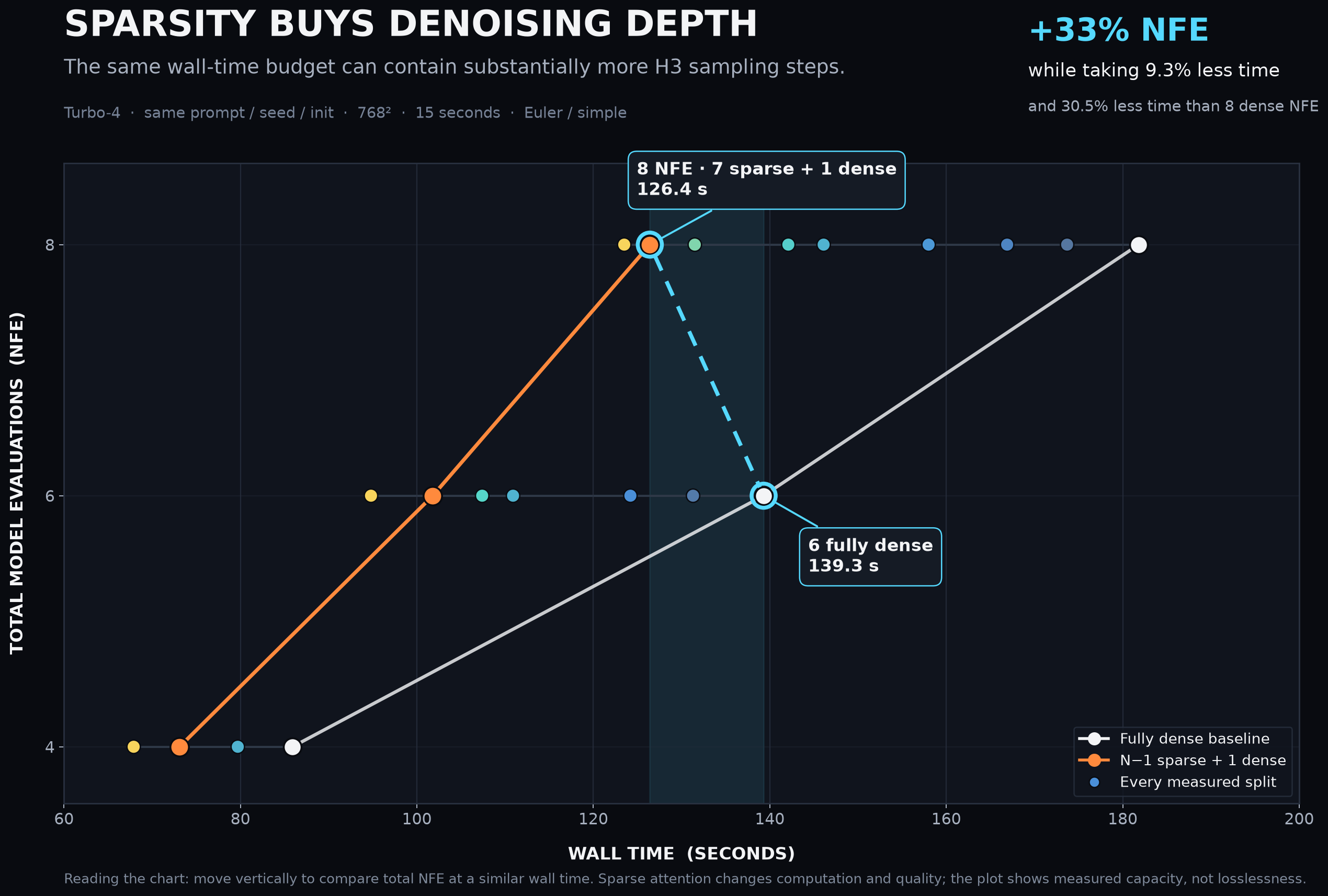
139.3 s
baseline
—
1 sparse → 5 dense
131.3 s
8.0 s saved
5.7%
2 sparse → 4 dense
124.2 s
15.1 s saved
10.8%
3 sparse → 3 dense
110.9 s
28.4 s saved
20.4%
4 sparse → 2 dense
107.4 s
31.8 s saved
22.9%
5 sparse → 1 dense
101.8 s
37.4 s saved
26.9%
All sparse · 6 steps
94.8 s
44.5 s saved
32.0%
Turbo 4
8
All dense · 8 steps
181.8 s
baseline
—
1 sparse → 7 dense
173.7 s
8.1 s saved
4.5%
2 sparse → 6 dense
166.9 s
14.9 s saved
8.2%
3 sparse → 5 dense
158.0 s
23.8 s saved
13.1%
4 sparse → 4 dense
146.1 s
35.7 s saved
19.6%
5 sparse → 3 dense
142.1 s
39.7 s saved
21.9%
6 sparse → 2 dense
131.5 s
50.3 s saved
27.7%
7 sparse → 1 dense
126.4 s
55.4 s saved
30.4%
All sparse · 8 steps
123.5 s
58.3 s saved
32.1%
Turbo 8
4
All dense · 4 steps
95.5 s
baseline
—
1 sparse → 3 dense
88.8 s
6.7 s saved
7.0%
2 sparse → 2 dense
81.8 s
13.8 s saved
14.4%
3 sparse → 1 dense
72.6 s
23.0 s saved
24.0%
All sparse · 4 steps
68.0 s
27.6 s saved
28.9%
Turbo 8
6
All dense · 6 steps
139.1 s
baseline
—
1 sparse → 5 dense
130.7 s
8.4 s saved
6.0%
2 sparse → 4 dense
126.0 s
13.1 s saved
9.4%
3 sparse → 3 dense
111.7 s
27.5 s saved
19.7%
4 sparse → 2 dense
104.5 s
34.7 s saved
24.9%
5 sparse → 1 dense
99.2 s
39.9 s saved
28.7%
All sparse · 6 steps
94.7 s
44.4 s saved
31.9%
Turbo 8
8
All dense · 8 steps
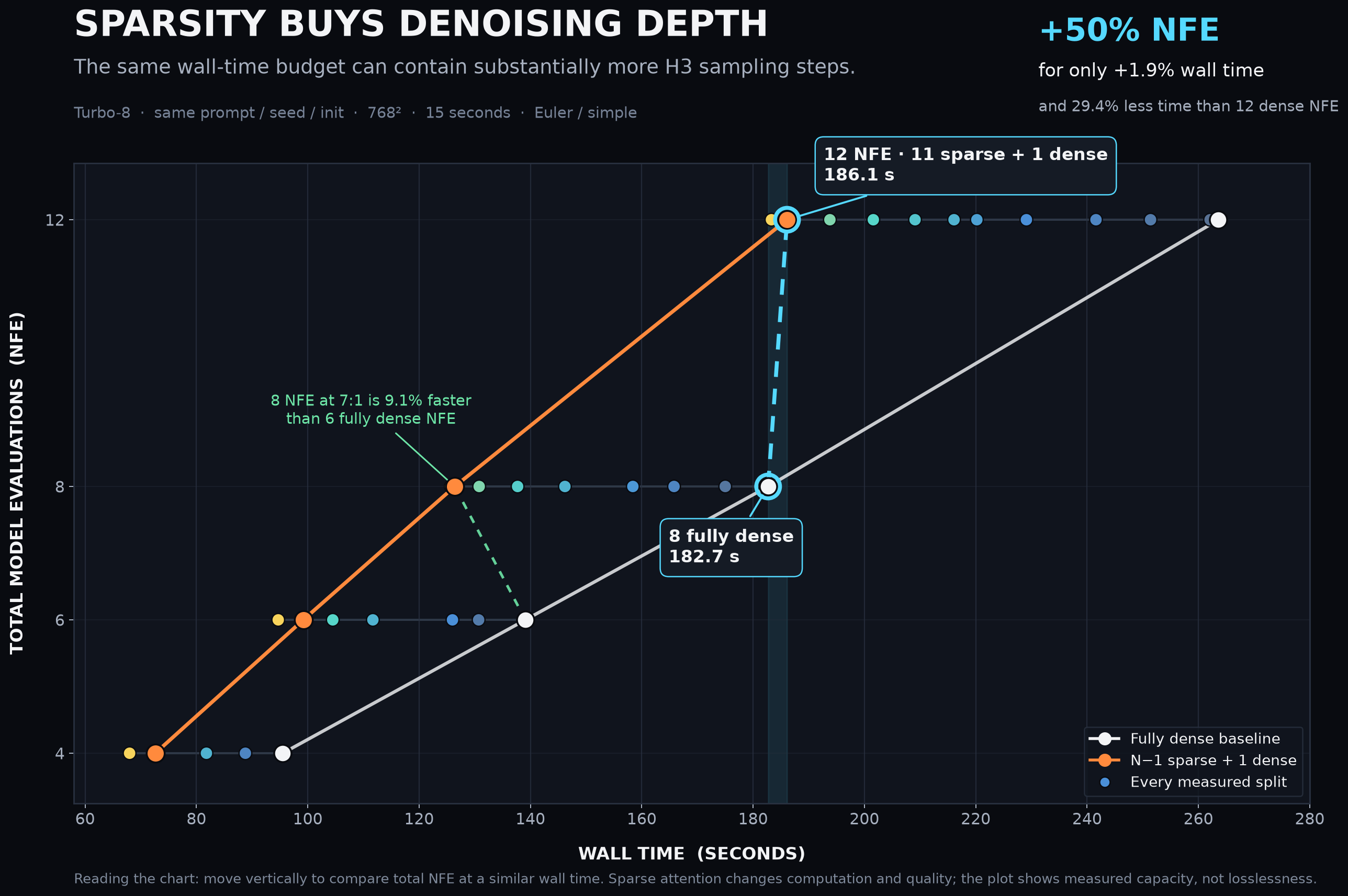
182.7 s
baseline
—
1 sparse → 7 dense
175.0 s
7.8 s saved
4.2%
2 sparse → 6 dense
165.8 s
16.9 s saved
9.3%
3 sparse → 5 dense
158.4 s
24.3 s saved
13.3%
4 sparse → 4 dense
146.2 s
36.6 s saved
20.0%
5 sparse → 3 dense
137.7 s
45.0 s saved
24.6%
6 sparse → 2 dense
130.8 s
51.9 s saved
28.4%
7 sparse → 1 dense
126.4 s
56.3 s saved
30.8%
All sparse · 8 steps
125.7 s
57.1 s saved
31.2%
Turbo 8
12
All dense · 12 steps
263.6 s
baseline
—
1 sparse → 11 dense
262.1 s
1.5 s saved
0.6%
2 sparse → 10 dense
251.4 s
12.2 s saved
4.6%
3 sparse → 9 dense
241.6 s
22.0 s saved
8.4%
4 sparse → 8 dense
229.1 s
34.5 s saved
13.1%
5 sparse → 7 dense
220.2 s
43.4 s saved
16.5%
6 sparse → 6 dense
216.1 s
47.5 s saved
18.0%
7 sparse → 5 dense
209.1 s
54.5 s saved
20.7%
8 sparse → 4 dense
201.6 s
62.0 s saved
23.5%
9 sparse → 3 dense
193.8 s
69.8 s saved
26.5%
10 sparse → 2 dense
187.0 s
76.5 s saved
29.0%
11 sparse → 1 dense
186.1 s
77.4 s saved
29.4%
All sparse · 12 steps
183.3 s
80.3 s saved
30.5%
Time-equivalent depth
Spend sparsity on more denoising
These two views isolate the practical exchange: a longer schedule can fit inside—or very near—the wall-time envelope of a shorter fully dense run when most early evaluations are sparse and the final evaluation is dense.
Turbo 4-step · measured RTX 6000 Pro S wall timeTurbo 8-step · measured RTX 6000 Pro S wall time
ComfyUI replication kit
One custom sampler. Everything around it stays stock.
H3-Optimizations 0.3.0 adds the exact integer-boundary sampler used here and no new Python dependencies. Import the workflow matching the Turbo adapter, choose the total schedule length in BasicScheduler, then set the sampler's sparse step count. The remaining evaluations are dense automatically.
Sampler / scheduler
Euler / Simple
Sparse attention
Kitchen INT8 · 30% video KV
Handoff
Same latent and sigmas · no fresh noise
Dense finish
Comfy Kitchen INT8
Focused A/B comparison
What one final dense step changes
Match every all-dense control against the schedule that keeps all but its final evaluation sparse. Start either player independently; starting one automatically pauses the other so their audio never overlaps.
A · Dense control
All dense · 4 NFE
85.9 sgeneration time
B · One dense finish
3 sparse → 1 dense · 4 NFE
73.1 sgeneration time
55-render addendum
Every integer handoff, three at a time
Choose the four- or eight-step Turbo family, select a total NFE budget, then move through each sparse-to-dense boundary in sets of three. Every sequence keeps the same first frame, prompt, seed, base checkpoint, Euler sampler, Simple schedule, and continuous latent. The sparse stage uses a 30% video-KV budget; the dense stage uses Comfy Kitchen INT8.
21 sequences
4-step Turbo gallery
4 total NFE
All dense · 4 steps
85.9 s
4 dense
dense timing baseline
4 total NFE
Sparse 1 → dense 3
86.1 s
1 sparse3 dense
0.3 s longer · 0.3%
4 total NFE
Sparse 2 → dense 2
79.7 s
2 sparse2 dense
6.2 s saved · 7.2%
Showing 1–3 of 5 schedules at 4 total NFE
34 sequences
8-step Turbo gallery
4 total NFE
All dense · 4 steps
95.5 s
4 dense
dense timing baseline
4 total NFE
Sparse 1 → dense 3
88.8 s
1 sparse3 dense
6.7 s saved · 7.0%
4 total NFE
Sparse 2 → dense 2
81.8 s
2 sparse2 dense
13.8 s saved · 14.4%
Showing 1–3 of 5 schedules at 4 total NFE
Context / prior art
Related work
MiniMax H3 was trained with native sparse attention, although its initial open release exposed full-attention inference. Contemporary work has explored training-free and learned sparse attention for video diffusion through systems including Sol-Attn, RainFusion, PASA, and SLA.
H3-specific community implementations have also introduced timestep-dependent sparsity. Scheduled H3 Sol-Attn ramps attention density through sampling; vLLM-Omni's Sol-Attn studyevaluates leading dense-step guards; and its RainFusion tail fallback adds an explicit final dense window. ComfyUI implementations from PlagueKind and Turing Utilsexpose related H3 sparse-attention and dense-guard controls.
This study adds a controlled, reproducible H3 Turbo ablation across every integer sparse-to-dense handoff at fixed 4-, 6-, 8-, and 12-NFE budgets, using matched inputs and publishing measured wall times and the complete output set for direct comparison.